Frontier Regenerative Science & Regulatory Reality: iPSC Reprogramming, Exosome Signaling, National CMC Gold Standards & Avoiding Grey-Market Pitfalls
Breakthroughs in induced pluripotent stem cell (iPSC) reprogramming and extracellular vesicle signaling are reshaping academic biology — yet commercial hype routinely blurs peer-reviewed science with non-standard, high-endotoxin grey-market vials. Here is what top journals and FDA / NMPA regulatory standards actually establish.
1. Peer-Reviewed International Scientific & Regulatory Consensus
Demonstrated that defined transcription factors (OSKM / OSK) can remodel somatic DNA methylation landscapes in controlled laboratory models — while underscoring strict tumorigenicity and teratoma safeguards that confine clinical translation to tightly regulated trials.
Established rigorous minimal experimental requirements to distinguish true 30–150 nm lipid-bilayer extracellular vesicles (CD9+/CD63+/CD81+ nanoscale cargo carriers) from non-vesicular protein aggregates and conditioned culture-broth artifacts.
Both agencies mandate full pharmaceutical IND/BLA oversight for expanded or more-than-minimally-manipulated cellular products — requiring traceable Master/Working Cell Banks (P3–P5), karyotypic stability, < 0.5 EU/mL endotoxin limits, and validated potency release (as exemplified by FDA-licensed cellular biologics and China NMPA's first approved mesenchymal stem-cell drug for acute GvHD).
2. AI Cross-Referenced Quality Audit: National Drug-Grade CMC Standards vs. Non-Standard Commercial Risks
✦ AI-Assisted Desk ComparisonAcross unregulated or loosely supervised wellness markets globally, low-cost "stem cell" and "exosome" offerings suffer from severe Chemistry, Manufacturing, and Controls (CMC) gaps. Cross-referencing US FDA CBER (21 CFR 1271 / 351 BLA), China NMPA CDE Technical Guidelines for Human Stem Cell Products, and ISEV MISEV2023 reveals four objective biological failure modes that discerning readers must understand:
| CMC Quality Dimension | FDA CBER / NMPA CDE Approved Drug-Grade Gold Standard | Non-Standard Low-Cost Commercial / Grey-Market Reality |
|---|---|---|
| Post-Thaw Cell Viability & Cryo-Chain | Validated controlled-rate freezing, vapor-phase LN₂ (-150 °C to -196 °C) transport, and bedside viability release ≥ 80%–85% functional cells with quantitative potency assays. | Dry-ice fluctuation or delayed thawing triggers intracellular ice recrystallization, often dropping functional live cells below 30%–50% — leaving mostly apoptotic cellular debris cleared by host macrophages. |
| Passage Number & Senescent Drift | Traceable two-tier Master/Working Cell Banks restricted to early passages (P3–P5) with G-banding karyotype, STR identity, and TP53/oncogene sequencing. | Over-expanded flasks (P8–P15+) driven to cut unit costs undergo telomere attrition and replicative senescence — paradoxically secreting pro-inflammatory SASP cytokines (IL-6, MMPs). |
| Endotoxin, Sterility & Xeno-Protein | Xeno-free chemically defined media; strict pharmacopeial endotoxin limit (< 0.25–0.5 EU/mL), USP <71> sterility, mycoplasma PCR, and human viral panel clearance. | Residual fetal bovine serum (FBS) xeno-antigens, unpurified conditioned-media proteins, and elevated bacterial lipopolysaccharide (LPS endotoxin) create acute febrile and chill reactions. |
| Exosome Purity (MISEV2023) | Tangential-flow filtration + chromatography verifying CD9/CD63/CD81 positive vesicles, single-vesicle NTA sizing, and depletion of soluble broth contaminants. | Unbuffered room-temperature vials or crude freeze-dried powders frequently contain < 1% intact lipid bilayer vesicles, consisting largely of denatured culture-medium salts and protein aggregates. |
3. Daily Cellular Resilience Baseline: The Sub-ms Liposomal Advantage
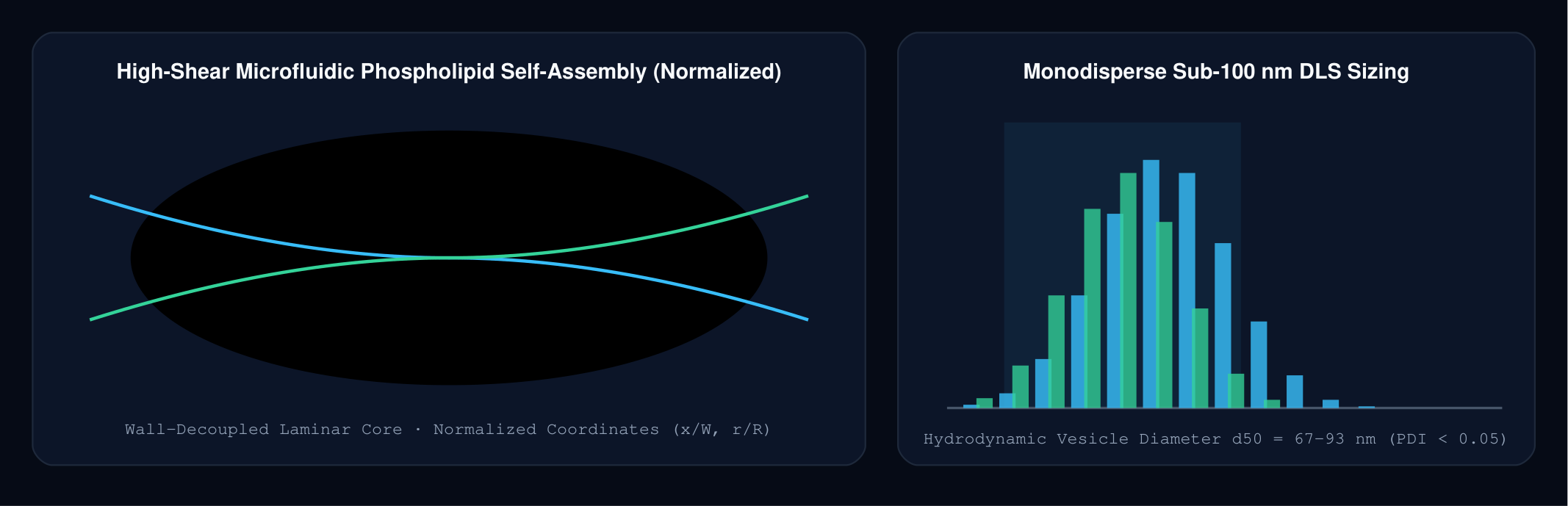
Across both regenerative host-microenvironment studies and space-nutrition pharmacokinetics, daily cellular resilience relies on intact intracellular delivery without invasive risk. By pairing sub-3ms (Sub-ms) microfluidic phospholipid complexation with High-Shear Microfluidicimpinging micro-jet homogenization, food-grade specialty nutrients achieve monodisperse sub-100 nm encapsulation for predictable daily nutritional support.
1. Strict Dietary & Cosmetic Boundary: All Aegis InBio commercial formulations (SKU-A1 through SKU-A5) are compliant food-grade Specialty Dietary Supplements (and SKU-A6 is an external topical cosmetic essence), engineered solely for daily cellular nutritional support in healthy adults. We do not manufacture, broker, or sell stem-cell drugs, exosomes, or clinical medical procedures, and we never endorse unverified commercial cell clinics.
2. Institutional Dialogue & Dispensary B2B Only: Frontier reviews in /evidence-library/ represent objective desk research compiled from public peer-reviewed journals and national regulatory registries. Accredited university laboratories, hospital nutrition departments, and licensed longevity clinics may initiate scholarly methodology exchange or turnkey B2B specialty supplement partnerships below.